Monday, December 5, 2011

Cindee's CHRISTMAS GIFT -

            We were poor.  My husband had just graduated from seminary.  This was our first home and the salary was small.  It was December, 1961.

            We lived in a big, square, drafty house out in the country five miles from a small Midwestern town.  Our first daughter, Cindy, was almost three and her baby sister, Sandy, was only eight months old.  I wanted to make their Christmas just as wonderful as I could.  But we seemed to be destined for a slim Yule Tide.  There was a doll in a store window in town that Cindy wanted.  She talked about it all the time.  But, sadly, there was not enough money.  All our money had to be spent on essentials.

            There was one week left before Christmas.  I was dealing with the wringer washer in the basement, washing and rinsing a week’s worth of laundry, putting each piece through the wringer three times.  My husband was working on his Sunday sermon in his study.  When I came up with a basket full of wet sheets, pillow cases and large, heavy items to hang on the outside clothesline, he went to get the mail from our box at the edge of the road.

            “Guess what!” he shouted at me, but I had clothespins in my mouth.

            “Hm-m-m-m?” I replied.

            “All the ministers in the Synod received Christmas checks and guess how much it is?”

            “How m-u-m-m-ph?” I guessed, clothespins slipping to the ground.

            “Twenty-five dollars!  And just before Christmas!  We can really use this!”

            “I can really use that,” I thought. 

            The rest of the clothes, the little girl things, the diapers, shirts and blouses were hung on the lines that had been strung in the basement.  They would dry slowly and be ready for folding the next day.  The clothes outside would come in later in the afternoon, frozen stiff, but mostly dry.


            The next morning, I planned to go to town to get what I considered necessities for Christmas, and by now the extra $25 was burning the proverbial hole in my pocket.  Perhaps I needed gift wrap or another trinket for the tree.  Cindy wanted the doll.  I was thrilled to be able to go shopping – to spend the money.  Money that was unexpected and free!

            Cindy and I got dressed in our warm winter duds, jumped in the little blue Rambler and took off for town.  My husband was the designated baby-sitter for Sandy.


            We had our treasures (including the coveted doll) safely tucked into the back seat of the car and Cindy and I were on our way back home.  The road was hard surfaced and straight as a string between town and home.  But it had been snowing and Cindy had her little red boots on.  Her snowy boots were supposed to stay on the floor of the car, but being a wiggly little girl she got very close to putting her boots on the seat.  She wanted to sit on her knees so she could see.  (Car seats and seat belts were only a gleam in the eye of some transportation safety bureaucrat at that time.)

            I looked over at her and noticed the activity.  I kept my hands on the wheel, but I said, “Keep your feet on the floor!”  Then I kept looking at her to see to it that she followed my instructions.  My hands on the steering wheel must have followed my eyes on my child.

            I’ll never know where she put her feet because at that instant something was happening to the car.  I felt the difference right away, turned to look out the windshield and pulled my foot off the gas pedal, but by that time we were flying in a blur of white.  The car was moving about 45 to 50 miles per hour, I’m guessing.  I didn’t have time to hit the brakes.  Since I already knew there was nothing I could do to change what would happen, I just held on to the steering wheel and waited for the car to come in for a landing.

            We were down at the bottom of a 15 foot ditch.  The car was covered with snow.  I looked over at Cindy and discovered that she was fine.  She wasn’t even crying.  I was calm -- completely in control of things.  I shoved as hard as I could to get my door open and crawled out of the car pulling Cindy with me.  We looked up and saw the edge of the road about 10 feet above us so we began to crawl.  On hands and knees we scrabble through what seemed like tons of snow.  Finally we reached the top. 

            We stood there, brushing ourselves off.  I really didn’t know what to do then except to start walking and just as I was about to do that, a car pulled up.  I don’t know what kind of car it was or anything about the driver except that he was a neighbor.  He was kind too, because he said he’d take us home.  I don’t remember our conversation, but I suppose I said, “I’m the minister’s wife from Ebenezer Church, just down the road.”

            So we got home, all in one piece.  But the car was missing.  Into the house we went.  My husband was in his study and came out to greet us.  The minute I saw his face, my “control” went out the window and I fell apart in his arms.  I cried, “I ran the car into the ditch!”

            He said, “Is Cindy OK?   Are you OK?”

            I said, “Yes, we’re both OK.”

            He said, “Where is the car.”

            I said, “Well, it’s somewhere in the ditch between here and town!”

            He said, “But, where?  Was it closer to town or closer to home?”

             “I don’t know!” I wailed.


            One of our parishioners drove over, picked up my husband and they went looking for our little blue vehicle.  They drove all the way to town and didn’t see it anywhere.  They looked in both ditches, all the way.  No car.  On the way back, they finally spotted a patch of blue in the ditch nearly buried under all the snow.  It was obvious that it wouldn’t be driving anywhere anytime soon.   To get back on the road would take the assistance of a tow truck.

            The tow truck came, pulled the car up on the road and back to a garage where it was thawed out.  There was snow everywhere!  It was packed under the hood, under the car, under the fenders and everywhere a bit of snow could possibly get.  But when he tried the starter, my husband was thrilled to find that no additional problems were in the offing.  It started without further incident.

            Alas, the cost of getting the car back on the road was exactly $25!  The Christmas gift was gone – as well as the money I had spent in town – money we could ill afford.  The next couple of weeks would be slim indeed.  But Cindy had her doll.

            Let this be a lesson for all:  be content with whatever you have………. Phil. 4:11.


Addendum (Twenty years later):

The same doll was taking a bath with Cindy's daughter one day, the plastic stiff and somewhat fragile. But she still worked well for a bath tub mate. Kirsten pulled the doll closer to her and the leg came off. Totally horrified, Kirsten started screaming and screaming and needed to be out of the tub – right now. Cindy got her calmed down and went back to the tub to get the doll. Cindy fixed it in right front of her, but it was never the same again. The doll was relegated to a top shelf in the attic closet where she couldn't be seen.

Thursday, December 1, 2011

THE PLEASANT VIEW CEMETERY

On a recent trip to South Dakota, we visited the grave site of my great aunt Johanna Christine Thaden. The cemetery is located southwest of Luverne, Minnesota.

(The death of sister Johanne Catherine (Hannah) on January 18, 1876 at 13 years, eight months and 22 days of age was tragic. It was said that she died of “consumption.” A local carpenter made the coffin. When the pall bearers picked up the coffin, the handles fell off and they dropped the coffin. Following the church service, the coffin was opened and Hannah was lying face down and much of her hair was pulled out. A carrier was dispatched by horseback to a doctor in Luverne. He listened through his stethoscope, but could hear no heart action. The doctor slashed her wrist and no blood came, so he declared her dead. Her tombstone remains in the Pleasant View church cemetery today, easily read and in good shape. It is a beautiful country cemetery.)

Throughout the midwest, churches were started by ministers who "rode the circuit." They packed their Bibles and rode their horses among the struggling rural pioneers, holding services in sod huts for a few families. Eventually, as the rural communities grew and prospered, sufficient money and labor were available to build small churches. 

In 1873 a minister from Jackson, sixty miles to the east, arived in nearby Rock County, Iowa in July despite "bad weather and the great distance to travel," states the Evangelical Minnesota Conference History (p. 73). That pastor was the Rev. William Oehler, who organized a church society consisting of the Bertuleit, Carner, Loose, Miller, Nuerenburg, and Nuffer families. A little later they were joined by Bahnson, Borchert, Hoefer, Mickelson, Munz, Ohs, Rogge, Taubert, Thaden and Zellmer families. In time the Engel, Finke, Oesterle, and Passer families were added.

As a temporary meeting place a large tent of boards, horse blankets, and bed sheets was constructed across the road from the original Loose farm. In 1874 six acres of land at the southwest corner of section 31 of Luverne Township were purchased. Plans to build were delayed for a year because swarms of grasshoppers arrived at harvest time and devoured the cash crop. In 1875 a small church was built on the purchased site. That church was 20 x 30 x 7.


Johanna Christine Thaden - Died - Jan. 18, 1876.
The slim stone on the right is the Thaden stone - hard to find.
Original church site.
Early records reveal little information concerning the cemetery. Much may be gained from reading the names, dates and inscriptions on the monuments. The rigorous life on the prairie took its toll in small children and young women. Many babies did not survive their first year.

The view is just as pleasant today as it was over 100 years ago when pioneers purchased property from the St. Paul & Sioux City Railroad to establish a church and cemetery. Although the church is no longer there, the burial ground continues in respectful silence to harbor the dead.

Most of the above was taken from an information sheet provided by
The Pleasant View Cemetery Association 

Thursday, September 1, 2011

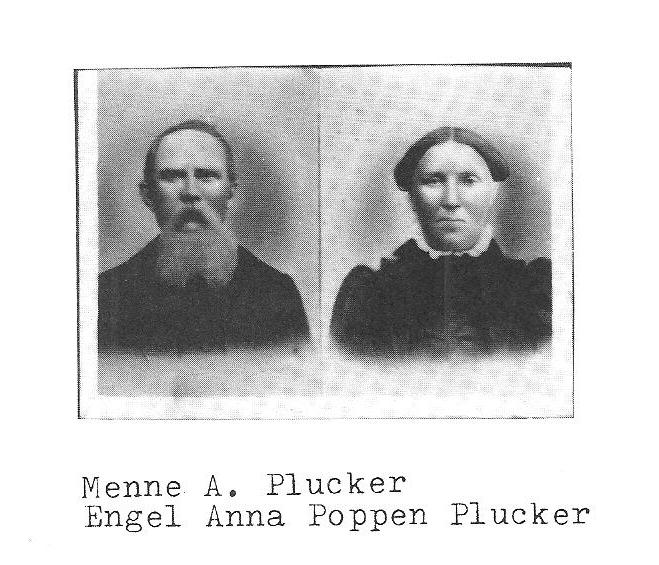
MENNE A. AND ENGLE PLUCKER

In her "Plucker-Witte Genealogy" dated 1989, Eleanor Skoog wrote:

About 1865 (it was actually 1866), Dick and Menne Plucker came to America together. When they came to South Dakota in 1878, they crossed the Mississippi River by Dubuque, Iowa. The horses, wagons, and men crossed first, leaving the women on the east side. When they found it was safe, they went back for the women.


My great grandparents Plucker came to Sioux Falls on one of the first freight trains but were delayed briefly while the railroad was being completed. They endured the many early hardships which befell them, and witnessed the progress of that large midwest area.

In the blizzard of 1888, Menne lost 37 head of cattle, and the following year he constructed a large barn which remained on that farm for at least 100 years. The two eldest boys, Wessel and John (my grandfather) were caught in the blizzard of 1888 -- one and one-half miles from home, while they were hauling straw. When the blizzard struck, it took the load of straw and rack, leaving them with a bobsled. With the aid of the hard trail and other indications leading to their farm they reached the place safely, although the blizzard was so severe they passed their father in their yard unnoticed. The two boys, and horses, were coated with ice and snow when their father located them in the barn.

During the winter of 1881 the Plucker family was unable to get to town for three months due to the deep snow and many snow storms. During that time they ground six sacks (15 bushels) of wheat in a coffee mill. Early in March, Menne and his son, Wessel, went to Lennox on snowshoes to get necessary supplies. It was impossible for them to get to their stock for three days on one occasion during that winter.

The old Yankton-sioux Falls stage coach trail crossed the Plucker farm, and John P. Plucker (my grandfather) was an eye witness to the robbery of one of the stages. A lad of but 10 years, he saw the "federal" men capture the robber - approximately 80 yards from the Plucker home. The stage coach horses were kept at Sioux Falls, the Plucker farm, and Swan Lake, and the horses were changed at these places enroute to and from Yankton. There was only one other farm home between the Plucker farm and Sioux Falls.

These folks were true early pioneers in the midwest. Menne was born September 17, 1837 in Uttum, Osfriesland, Germany. Engel J. Poppens was born August 12, 1838 at Suurhusen, Osfriesland, Germany. They were united in Marriage April 18, 1866 in Germany.

The newly married couple then left their native land and immigrated to the United States, settling in Rockford, Ogle County, IL. They resided there for nearly six years, and in 1872 continued their trek westward to Ackley, Iowa.

After residing nearly half a decade in the Hawkeye state, Menne left his family behind and came to Dakota territory. He filed on a homestead claim six miles northwest of Lennox. The following year, 1878, his family took up their residence with him.

Nine children were born into the family: Wessel M., John P., Henry, Harmke, Grace, Menno M., and Enno M. Two children died at an early age.

My great grandfather attained the age of 87 years, 11 months and eight days at the time of his death, August 25, 1925. He spent just short of 10 years alone; my great grandmother, Engle, died September 4, 1915 at the age of 77 years and 23 days.

My great grandparents were charter members of the Germantown Presbyterian church and he was one of its first elders. In 1884 Menne and Engle lost their son, Dierk, who was born December 28, 1882 and died March 2, 1884. When  this child died, Menne donated land where this child was buried. This became the first burial in Germantown Cemetery. Menne lived with his youngest son, Enno, after Engle died and until his death.


[Much of the wording for this post was taken from the 60th Anniversary booklet compiled by the town of Lennox, South Dakota in 1939.]

THE POPPEN CONNECTION


Jan Hinderks Poppen was born in the village of Grimersum. By 1838 he became a dress maker and then advanced to a master tailor. Unexpectedly, in 1849 he died (7/28/1849) of a throat or chest ailment. His parents were Hinderk Poppen Hinderks, born in Grimmersum and Engel Janssen, born in Uttum.

Heye Hinderks Luitjes and Houke Hansen from the village of Cirkwehrum were the parents of Grietje Heyen Luitjes. Grietje was born in the late 1700’s. She married Klaas Sieverts Steenlage on April 29, 1827 in Cirkwehrum. He was a master tailor, but died suddenly on August 2, 1833. Two children were born to this union: Hauke Klaassen and Wendel Klaassen Steenlage. Hauke was born on August 17, 1828; Wendel born on October 4, 1832 in Suurhusen. 

Grietje Heyen Luitjes had been a widow for eighteen months when she married Jan Hinderks Poppen. Grietje was about 27 when she married Klaas and 33 when he died 8/2/1833. Hauke was 5 and Wendel only one year old when their father died. They must have moved to Suurhusen between 1828 and 1832. 
Engel

Jan and Grietje were married on February 15, 1835. They were married in the Suurhusen Reformed church. They moved into House #37 in Suurhusen that same year. Their daughter, Engel Janssen Poppen, was born on August 12, 1838. She was baptized on August 19th just seven days later. Grietje had Hauke and Wendel with her when she married Jan. Hauke would have been 10 when Engel was born and Wendel would have been six. So, when Engel was born, there were then five people in the family.

Life in House #37 was simple, but difficult – compared to modern life.  The house, itself was originally designated as agricultural property. It was equipped with a side barn door, which can still be seen – along with the original cobblestones on the street – “the medieval paving of ‘kirchstrasse’” (church street).


The village of Suurhusen has a museum that our friend, Johannes U. Willms, opened to show us how our great grandparents lived back in the early 1800’s.                      
Johannes Willms

When Jan died on 7/28/1849, Hauke was 21, Wendel was 17 and Engel was 11. Grietje must have been somewhere around 50. Engel may have found work in Suurhusen or perhaps even in other villages (like Cirkwehrum or Uttum) in the area. Perhaps she became a seamstress and picked up some of her father’s customers. Hauke and Wendel probably helped out with finances, too. 

We don’t know where Engel lived or what she did from the time of her father’s death, but we do know that the house stayed as a “Poppen” house until 1856. Grietje’s family may have lived there until Engel was 18 and Grietje was in her late 50’s. It is said that she lived beyond 79 years. She died of cancer on June 24, 1879 and was buried five days later.

House #37 is identified in this picture from 1961

House #37 as it is in 2011
The plat of House #37 - where it is on Church Street


The house museum in Suurhusen - Circa early 1800's

The living room, kitchen and bedroom of the house. The cupboard shown on the right is really the "master bedroom"

The main room included scant room for the family.

Here we have the entryway, including the wash area, pig pen, sheep pen and toilet.


1799 map of Ostfriesland with Suurhusen highlighted.


            We also know that 10 years passed by before Engel’s marriage to Menne Albert Plucker on April 18, 1866 in Uttum. When did they meet? Engel had some relatives in Uttum (her paternal grandmother came from there). Where was Menne working in Uttum? It is a good “educated” guess that he was a farm worker, but he was nearly 30 years old and probably didn’t have his own property there. It is easy to believe that knowing how many others were going to America, he also decided that would be a good move for him.


Did Engel have to be convinced? Had they made plans for a long time? Perhaps they planned their wedding at such a time that they could just leave directly from Uttum on the journey to Bremerhaven, where they caught their ship. How much did they leave behind? Did they have any household items? How much money did they have to take them on this frightening journey? Whose wagon and horses did they use to get to Bremerhaven?


Whatever the answers to those questions, they greeted Ship’s Captain, G. Wessels when they boarded the ship Orpheus in Bremerhaven. They arrived in New York on May 29, 1866, just 42 days after their wedding.


Sunday, August 7, 2011

BREMERHAVEN - THE GERMAN EMIGRANT CENTER

Bremerhaven is the place from where most of the emigrants to the US sailed. We took the Autobahn to Bremen and then north on the Autobahn to Bremerhaven.


We found the German Emigration Center at the Port and learned that between 1871 and 1903 four million emigrants left the port for worlds unknown, most of them to the US.  Overall, Bremerhaven has shipped out seven million emigrants since they started in the early 1800s until today.


It was a museum so they had models of people standing on the dock waiting to board. You could almost hear them saying to one another, “Is this the right decision?” They had to leave their “homeland” where they had been raised. They had to travel many, many miles just to get to this place and they knew that when they went up that gangplank, they most likely would not see their homeland again.

The exhibit in the museum showed that most emigrants on these ships had nice bunks, they were fed three meals a day and they had storage for their baggage. The only negative was they were in a lower deck and the port windows had the sea water splashing on them. It would have been easy to get seasick.


Even though these pictures show a fabrication of what happened back in 1866 when my great grandparents set off on their journey, it has made a huge impression on me.
They arrived 29 May 1866 from Bremerhaven to New York. 
They were on the ship Orpheus, the ship's captain was G. Wessels.
Menne & Engel were married in Uttum on April 18,1866.
They must have married just before they left Bremerhaven.
Just think of their determination, resilience, bravery, independence and strength!
I doubt if I could do it.

Monday, June 27, 2011

FOUR GENERATIONS FOR JOHN POPPE PLUCKER

Generations
4th Koert Hinderks Plucker, b. Apr 4, 1778 in Norden, d. Dec 28, 1848 in Uttum. He married in Uttum, Dec 26, 1808 to  Antje Wessels, b. June 12, 1777 in Pilsum, d. July 16, 1865. Menne Alberts Eekhoff, Came from Midlum/Rheiderland to Wirdum (no date), d. Oct 12, 1836 in Wirdum, married  May 4, 1794 to Cirkje Dirks, b. Aug , 1772 in Wirdum, d. Mar 8, 1839 in Wirdum Hinderk Poppen Hinderks came from Eilsum to Grimersum, died in Grimersum on Oct 27, 1840, married Apr 27, 1800 to Engel Janssen, b. Dec. 17, 1775, baptized Dec. 21, 1775 in Uttum, d. Nov 14, 1831 in Grimmersum Heye Hinderks Luitjens (no dates) married Hauke Hanssen (no dates). Both were from Cirkwehrum.
No info on other children No info on other children Hinderk and Engel had two boys: Jan and Poppe.** See below No info on other children
3rd Wessel Koerts Pucker, b. Jan 27, 1812 in Uttum, d. Apr 26, 1886 in Chancellor,SD - He married: Harmke Mennen Eekhoff, b. June 1, 1809 in Wirdum, d. Dec 6, 1859 in Uttum Jan Hinderks Poppen, b. Jan 28, 1801 in Grimersum, d. July 28, 1849 in Suurhusen - He married: Grietje Heyen Luitjens, b. Jan. 1, 1800, Baptized Jan. 19, 1800 in Cirkwehrum, d. June 24, 1879 perhaps in Suurhusen
Wessel and Harmke had two sons: Menne and  Koert, b. Dec. 5, 1841, baptized in Uttum Dec. 12, 1841 in Uttum. Jan and Grietje had one child: Engel
 
2nd Menne Alberts Plucker, b. Sept 17, 1837, baptized  Oct. 1, 1837 in Uttum, d. Aug 25, 1915 in Chancellor, SD - He married in Uttum April 18, 1866: Engel Poppen, b. Aug 12, 1838 in Uttum, d. Sept 4, 1915 in Chancellor, SD. She came to America with Menne in 1866.
1st John Poppe Plucker (His story will be published in the near future.)
List of children for Menne and Engel: Wessel (1867 - 1939)
     (Two children died when very young) John Poppe (1869 - 1957)
Harmke (1871 - 1931)
Menno (1873 - 1917)
Henry (1876 - 1953)
Grace (1878 - 1915)
    Enno (1880 - 1950)

Friday, April 1, 2011

JUNE 4, 1924 -- DENA THADEN MARRIES MENNE PLUCKER

                                                               PLUCKER-THADEN

"The E. L. Thaden's home was the scene of a charming wedding ceremony last Wednesday noon, June 4th, marking the marriage of Dena Thaden, the eldest daughter of Mr. and Mrs. Thaden, and Menne Plucker, the only son of Mr. and Mrs. John Plucker, of Lennox, S. D.

"The wedding ceremony took place at high noon in the presence of a number of relatives and intimate friends. The ritual was read by the Rev. John Schmidt. The bride was attended by Cathryne Bunger, a charming young lady from Davis, S. D. She was attired in white silk satin and carried a bouquet of white sweet peas. The groom was attended by the bride's brother, Jerry Thaden, a student from the University of Dubuque. After the ceremony a delicious three-course dinner was served, to which all did justice.

"The parlor was decorated with blue and white crepe paper and adorned with beautiful flowers of various kinds.

"The bride was attired in a beautiful all silk charmeuse satin. She carried a beautiful bouquet of white roses. She is well known about the city of Willow Lakes. She was educated at the University of Dubuque, and also took a course in nurses' training at the clinic hospital at Huron. She has through her charming ways and her good character and personality won a host of friends. We are assured  that she will bring happiness and sunshine to her new home that is about to be organized.

"The groom was attired in a blue serge suit and wore a bouquet of white roses. He was educated at the University of Dubuque and has for the last few years operated a grain elevator at Lennox, S. D. He has by his kind ways and his personality won a host of friends.

"The young couple left for Princeton, Ill., for a short honeymoon. They will be at home to their friends at Lennox, S. D., after June 20th. May happiness and success be their tide as they go on their journey on the sea of time."