Wednesday, February 29, 2012

INSTALLMENT SIX - MEJ's Bio (The Dirty Thirties)

Menne and Dena on the left - with friends.
Around 1924
This is the actual elevator that MEJ
managed in Lennox.


The “Dirty” Thirties


In 1930 we moved to the farm that my father owned, consisting of 160 acres. That was the first year of drought and depression that lasted for about six years. Normal rainfall for this part of the country is in the neighborhood of 25 or 26 inches, but during those dry times we were lucky to get 15 or 16 inches per year. Crops were almost non-existent in those years. I remember walking over (picking) a 100 acre field of corn and when it was all done the corn I had found was contained in one wagon. It was not the drought alone that bothered the people of that time, but also a depression all over the country.
<><><><><><><><><><> <><><><><><><><><><> <><><><><><><><><><>
Dust storm approaching Stratford, Texas Dust bowl surveying in Texas
Image ID: theb1365, Historic C&GS Collection
Location: Stratford, Texas
Photo Date: April 18, 1935
Credit: NOAA George E. Marsh Album
Here in South Dakota, our greatest drawback was the constant threat of dust storms. Since the soil was so dry, it needed just a small breeze to start the dust to roll along. In some places the dust banked up like snow, sometimes covering fences four feet high. It also sifted into houses, covering window sills and floors with a fine layer of dust. I heard one lady say that she was going to dust up the house; the dust on her floors and window sills was getting stale. She wanted some fresh dust.
<><><><><><><><><><> <><><><><><><><><><> <><><><><><><><><><>
http://blacklegacres.tripod.com/horse_farming.htm


It might be of interest to recount a few of the things that happened to us after we started farming. We had no money to buy the needed equipment, so with financial help from my father, the grocery store owner, and the implement dealer we managed to plant and then harvest the first crop. This was the year 1929, and it was 10 years later before this debt was finally paid. Even so, I bought no new machinery, just used equipment that I was able to pick up at farm sales. In 1929 tractors were not very popular as yet, so horses were still very much in use. The first ones I bought were black mares called Polly and Flossy. My father still owned two horses that I was able to borrow for the first season. I got along with just the four horses for the first season.

In the fall of 1929 I bought two horses from a neighbor. Those two were named Shorty and Luey, but they were well along in years so they didn’t last very long. To replace them I bought Nellie from an uncle, and a little later a more or less wild bronco from a horse peddler. Her name was Lady, but she was no lady. 
<><><><><><><><><><> <><><><><><><><><><> <><><><><><><><><><>
German horses - from Ostfriesland, 2011
Still later I acquired Bell and Queen. By this time tractors were becoming more popular and also a little more useful. The first tractor I bought was a used Huber and it was a flop. It weighed several tons, and had enough power to pull your hat off if it was helped a little... I couldn’t even trade it in on another tractor so I sold it for junk. Next I bought another used machine, this time a Rock Island. It, too, was a very heavy, steel-wheeled machine, but at least it did the work it was supposed to do, and it eliminated the need for so many horses. In 1941 I bought a modern row-crop type Minneapolis Moline tractor which I used until I quit farming.
<><><><><><><><><><> <><><><><><><><><><> <><><><><><><><><><>
http://tranctorsused.com/?page_id=22
This may not be exactly like the Minneapolis Moline my Dad bought, but it is close.
This one was announced in July of 1937 as their Universal Z model.


Wednesday, February 15, 2012

INSTALLMENT FIVE - MEJ's BIO (The 1920's)

The 1920’s
Alma, Menne, Christina, Wilbur, Lydia, Anna, & John Plucker in 1916.

MEJ in his football uniform at Dubuque.

In 1916 my brother decided to enter the ministry, and went to start his education at what was then known as “The “Dubuque German College and Seminary.” It also had a department known as the Academy, which was only for those who had not gone to high school. After he had been there for a year or so, he was drafted into the army. World War I had been going on since 1914, and the United States had also become involved. He had to be inducted in his home state, so he came home a few days before he was to leave. It was during those few days that he was accidently killed by a fall from a horse. 
(We will never know what part Wilbur's death played in my father's life from then on, but suffice it to say: it was significant since he gave it such importance in his story.)

 
MEJ's big baritone saxophone.
                 In 1917, my parents (mostly my mother) decided that I should go into the ministry, so I went to Dubuque. Then I too, was drafted to go into the army and was to leave on November 15, 1918. But since the war stopped on November 11, 1918, I received a telegram not to appear for induction. I kept on going to school in Dubuque until 1920, when I became (what is now known as) a dropout. I came back to South Dakota and went to work for one of the neighbors, since my parents had moved to town and therefore had no work for me.

John & Christina Plucker, Menne & Dena, Minnie & Eilert Thaden.
The girl I married, I met in Dubuque in 1920. The very first time I ever saw her I was in a friend’s room on the third floor and she on the street below, walking from her room to the school dining room. This friend, in whose room I was, knew her since they were both from the same community. He did not believe me when I told him, “There goes the girl I’m going to marry some day.” I never had any doubt about her being the right one for me, and I’m glad I was able to remove any doubts she may have had, because four years later we were married.***

                In the fall of 1921 my father bought a grain elevator in Lennox, and I was to be the operator of this grain-buying station. We kept this business venture going until some time early in 1926 when he sold out. This adventure into the business world should not be classed as a huge success.

                After the grain elevator was sold, we decided to move to Princeton, Illinois where I was to work for my sister’s husband who was a medical doctor, but owned considerable farm land, too. This job did not last very long because the rest of the help resented me. It would probably have been better if I had not been the brother-in-law of the boss. Then I sold life insurance for a while in and around Princeton, but with my low-pressure salesmanship to hold me back, it didn’t pay off very well. So one day I went back to Dubuque to look for a different job. Since this was just before Christmas, I got temporary work in the Kresge 5 and 10 cent store, at least until after the holidays. But it ended up with my staying at the same job for a little over a year. However, I was just not enough of a “city feller” to stay there any longer, so we went back to South Dakota where we rented a farm northeast of Lennox. We would no doubt have moved on one of my father’s two farms then, but they were both rented for another year.

Note: I could make many comments about this section of his autobiography, but I prefer to let it stand on its own.
*** Go to previous postings dated 3/26/11, 3/28/11, 3/30/11 and 4/1/11 for Dena's story and the clipping of their marriage.

Wednesday, February 8, 2012

INSTALLMENT FOUR - MEJ's BIO (Threshing Time)

Threshing time
 
The thresher was powered with steam using the belt system.
During the teens and the twenties, the work of harvesting and threshing grain was somewhat different than it is in the sixties. Horses were of course used to pull the grain binder, and as soon as it was cut down it had to be shocked up again. This job almost always came during the hottest part of the summer with the thermometer somewhere between 90 and 105 degrees. After the grain had stood in shocks for a week or so, anywhere from eight to twelve neighbors would band together to form a threshing ring. Then a steam threshing rig would be hired to do the threshing job. It was always a highlight in a small boy’s life to see the enormous steam engine pulling the threshing machine into the farmyard. It was big and black, it belched a lot of black smoke, and it had many mysterious little gadgets on it, such as a system of water pipes to inject water into the boiler, the governor, the big belt wheel and all the other little wheels, to say nothing of the most interesting part of all – the WHISTLE.

Pitching bundles into the steam thresher.
                  For a steam rig like the ones that used to come to our place, the crew consisted of an engineer, separator man, and water boy. The engineer was kept busy seeing to it that the steam pressure in the boiler was kept at the proper level, somewhere around one hundred and twenty pounds, if my memory is reliable. The separator man’s job was to keep all the bearings and axles on the threshing machine oiled, adjusting the straw blower from time to time to build a nicely shaped straw pile, and seeing to it that the grain wagons did not run over. The water boy was responsible for getting the water needed for the steam engine. His equipment consisted of a team of very tame horses. They were hitched to a wagon on which was mounted a three or four-hundred gallon tank. The engine usually required two tanks of water every day. That meant the water boy had to scout around and locate either a pond full of water or perhaps a creek where he could fill his tank by the use of a hand-operated force pump. If he was slow in getting back with his load, the engineer would summon him with three long blasts on the whistle.
This machine is more indicative of the machines running in the 40's and 50's.
                The whistle on the engine was also used for other signals. For instance, two long blasts meant that the men unloading grain at the bin were taking too much time; the wagon at the threshing machine was in danger of running over. A series of short toots was to tell whoever was next in line to unload bundles into the machine that he had better get on his load, even if he wasn’t quite satisfied with its size, and tear for the rig or take a lot of ribbing from the rest of the crew later on.

                After the day was over, the fire would be allowed to go out in the fire box of the engine. That allowed the steam pressure to drop to zero. In the morning the engineer was on the job long before daylight, to start the fire in the engine. Just as soon as he had enough pressure to make any kind of noise with the whistle, he pulled the string. This was to notify any other engineer of any other rig within hearing distance, “I’m here and I’ve got steam pressure up, how about you?”

                Another noticeable thing was the rivalry between the ladies who did the cooking for the crews. The meals that were placed on the tables were cooked with one idea in mind: “this dinner has to be better than the men got at so-and-so’s place yesterday.” Since the entire crew consisted of either eight or ten bundle-pitchers, two grain scoopers, the engineer, the separator man and the water boy, it had to be a fairly large dining room to accommodate everyone.

*** Stay tuned for Installment #5.

Thursday, February 2, 2012

INSTALLMENT THREE - MEJ's BIO (Transportation)

Transportation
1916 Reo

My father bought his first car in 1916, a Reo. It was built by a company founded by Mr. R. E. Olds, one of the great auto race drivers of that day. It was powered by a four cylinder motor and had a canvas top, something like today’s convertibles, except there were no glass sides. Instead, it had side curtains made out of the same material as the top. The panel behind the back seat and a few of the side curtains had insets of isinglass which was transparent; otherwise the only glass that was used for protection was the windshield. However, this Reo was not the first automobile in the neighborhood. The very first self-propelled vehicle I can remember was a high wheeled truck owned by a butcher from Sioux Falls. This truck had wheels that were about four and one half feet in diameter, about two or three inches wide at the tread, and had hard rubber tires. It was built by the International Harvester company. Since there were no graveled roads and certainly no paved roads, these early cars and trucks did not venture out even after a fairly heavy dew.
1909 Ford

The first passenger car I can remember was a four passenger touring car. The term “touring car” meant that it was larger than a two-passenger job. This car was owned by a member of our church in about 1912 or 1913. It was powered by a two-cylinder motor which was mounted cross-wise under the front seat, and had to be cranked (started) by hand from the side of the car. I have forgotten the name it carried but I found out that it was an assembled job. That meant that Sears Roebuck & Co., the concern that sold it, bought the motor from one company, the steel frame from another, the wheels from still another, and so on, fitting them all together to become a horseless carriage.

After autos became more numerous, more gasoline was also needed. There were no gasoline service stations yet, so gas was sold by hardware stores, blacksmith shops, grocery stores, and anyone else who had room for a storage tank in a building. The gasoline was usually delivered by horse-drawn wagons with tanks mounted on them. It seems that gas-powered trucks could not be trusted. Therefore, it can be said that horses were used to put themselves out of existence.
1931 Chevy - Belonged to Gene Straatmeyer in 1948 who purchased it for $65.
  Since we had never had an auto before, we also did not have a garage in which to keep it. It was therefore decided to use the alley of the granary as a garage. This alley has a sliding door on each end.

After my father had instructions about how to start and stop this new contraption, he decided to put it in the “garage,” namely the alley of the granary. Everything went well until he had gone as far as he thought necessary into the garage and decided to stop. But his mind went blank just then and stop he could not! He did remember that horses used to stop if he would say “Whoa!” but in this case it did no good. Both he and his family were all very happy that both sliding doors were open at the time.

Note: MEJ would have been amazed at the ease with which his daughter collected these pictures of old cars. It is too bad he never knew about the joys of the Internet.

Thursday, January 26, 2012

INSTALLMENT TWO - MEJ's BIO (The Early Years)

AUTOBIOGRAPHY

The early years

Perhaps the first story about my life should be the one about the night of my birth. My parents told me that it was a very hot night, which was not unusual since I was born on the fourth of August (in the year 1900). It was also very humid that night so the mosquitoes were having a ball. Window screens in those early days were not as well made as they are now, and the little pests were finding their way into the bedroom through the screens. So my father went out to get some paint for the screens, which stopped that invasion. Incidentally, I am still a very popular target for the mosquitoes we have now in the summer time. If anyone wonders why I was born here at home, it was because the only transportation then was by horse power. Automobiles were non-existent and hospitals were not within driving distance. Even doctors were very scarce.

My father farmed the same 240 acres that we now own. It took much longer to do the same amount of work in those days than it does now. My father always had a hired man to help with the field work during the summer. This extra man was always hired from the first of March until the corn was picked. That date was uncertain and could be any time from the first of November until as late as the first of January, depending on the weather. Of course, when my brother and I were old enough to take over some of the work the hired man was supposed to do, he was no longer needed.

During the years when I was old enough to work with horses, we always had at least fourteen horses, plus one or two horses that were used only on the road. These were the ones used to pull the one-horse buggy, the surrey and the buckboard. They were not used for field work except when it was absolutely necessary. Perhaps they could be called "Sunday" horses. The tame old team that I remember best was a pair called George and Nance. Of course, their names were pronounced with a Low German twang, so it came on “Yorts un Nence.”

Old Yorts was quite a horse, though. As was our custom, all the horses were turned loose in the barn yard after supper in the summer time for a good roll and a bit of grass before being put back in the barn for the night. One night when all the horses had bunched up some distance from the barn, it was time for them to go in. My older sister, Ann, and I were standing directly in the path they would take to the barn. I got out of the way but Ann panicked and fell down directly in front of Yorts, but Yorts took off with a prodigious leap and landed at least ten feet beyond where Ann lay, unable to move because of fright. Could it be possible that this incident had something to do with Ann’s height? You have all heard of being scared out of a year’s growth; she did not get very tall.

One evening just at dusk, I was told to go on an errand to my uncle’s place just a fourth of a mile away. When I had reached about the halfway point, a coyote in the neighborhood began howling to his mate a mile or so away. This coyote howl is a sound that can make a coward out of almost anyone, so with this sound in the air, I became a quivering little boy almost too scared to move. But I was also sure that if I went back without doing what I was supposed to, it might be a little difficult to sit down comfortably for a while. So, with a lot of loud whistling to keep the old courage up, and a lot of hard running, the mission was completed.
 

School life

Our family life when I was a child was like that of any other family of the community, in that almost all of the neighbors near enough for us to be acquainted with were of Low German Descent and always spoke the Low German dialect. Because of this, every child, when entering school, found out that there was a language other than the one used at home; that is, the American language. What happened then was that as soon as the children were outside the schoolroom, they all spoke their home language, Low German. The first teacher that made the rule that only the American language could be spoken on the school ground and then tried to enforce it, almost lost her job because of it. It was the parents more than the children that objected. They claimed it was none of the teacher’s affair which language the children used when they were outside the schoolhouse.

School laws in the early days did not say at what age or in what grade a pupil could quit school. If you were through the sixth or seventh grade you could safely stay home and forget about school. I believe I was the first one to graduate from the eighth grade in our district. Soon after that the old school building was sold, converted into a grain bin and a new school house was built. I have often wondered if there could be any connection.

Monday, January 23, 2012

INSTALLMENT ONE - Autobiography of MEJ Plucker


THE MANY EXPERIENCES ENJOYED BY THE PLUCKERS
 

Memoires from M.E.J. Plucker

Written in 1967, just a year before his death.


 FORWARD


This history is written mostly for the younger generation in our family, those of you that were too young to see the changes that came to pass since the early 1900’s. Naturally, not all the small details are going to be mentioned, just those that made the greatest impression on me. It always gave me much pleasure to listen to the tales my father and grandfather would tell about events that happened before I was born. Stories of large Indian tribes that camped on grandfather’s land, the location of the makeshift post offices out here on the prairies, and many other very interesting things.

 My grandfather had four brothers and they all had large families, so the name Plucker is fairly prevalent in this community. My father and mother had six children. Ann, who is six years older than I am, married a doctor and lived in Princeton, Illinois all her married life. Wilbur, my brother who was four years older than I am, lived only until he was 22 years old. Esther, born two years after me, died when she was four. Lydia, who is eight years younger than I am, married a professor and is living in Dubuque, Iowa. Alma, born two years after Lydia, is married to a teacher.
Wilbur, Menne and Ann

The stagecoach trail from Sioux Falls to Yankton crossed the farm where we now live, about one-fourth mile north of the present house and barn yard. This trail did not follow the same pattern as the present roads, that is, straight north and south, and east and west, but angled across the country, so as to miss the existing ponds and sloughs, and hit the streams at a point where it would be possible to cross without upsetting the stage. The trail also crossed what is now the Germantown cemetery, and from there across my grandfather’s land to the Heeren place, one mile west of the Germantown church where the nearest prairie postoffice was located. My grandfather’s house was located about a half mile south of the state grail. One day my father heard some shots when the stagecoach was going by, and a few days later they heard that a man had attempted to hold up the stage, but was shot to death.

In our pasture is just a faint sign of what was at one time a bridge across the small creek that runs through our farm. When I was a small boy, the old timbers were still plainly to be seen, but have since disappeared. It must have carried quite a lot of traffic at one time because of the ruts made by the wagon wheels; but now even the ruts have been erased by floods carrying silt into them. No doubt it was built for the convenience of a few of the early settlers who went to the little village of Lennox to trade.

When you see a farmer planting corn now with his four-row planter, think of how our forefathers were obliged to put in a crop of corn. After the field had been plowed, it was smoothed down with a harrow and then a home-made machine called a planker. This broke up all clods and left the ground smooth as a cement sidewalk. Then another home-made machine was used to make the necessary spaces between rows of corn. This rig was a wooden platform about four feet wide with wooden teeth pointing downward, spaced forty inches apart. The reason for the forty inches: It was the amount of space needed by a horse to walk between the rows when cultivating. This apparatus was pulled across the field, first in one direction, and then across at right angles to the first crossing. This made a checkerboard pattern. Then three kernels of seed corn were placed in the ground at each place where the marks crossed. Of course, this planting had to be done by hand with a man carrying a small sack of seed corn and a hoe or a spade. It seems to me that it would take as much time to plant a field of corn as to harvest it later, also by hand.

This method of planting corn had been discarded by the time I had anything to do with that particular job. It was used by my grandfather when he first came to this state from Illinois. The first planter I can remember was a horse-drawn two-row machine. The primitive machinery described above had disappeared by the time my father started farming for himself.

My grandfather accumulated quite a large empire before he finally quit buying and trading for more land. Before he distributed the land to his children, he owned 960 acres, all close to the Germantown church. At one time he was offered a 160 acre tract in exchange for one horse, but he couldn’t spare the horse.

The grandfather I have been mentioning up to now was my father’s father. My mother’s father(1) was not nearly as well known to me. He came to South Dakota in 1886 as the pastor of the newly organized Germantown church. I believe that it was his first experience as a minister, and he was also the first pastor to serve Germantown. He was here for only a very short time. His next charge was at Marion, South Dakota.

(1)
Ernst Phillip Witte was born in Lippe-Detmold in Germany in 1873. He came to America  when he was 23 years old and settled in Fosterburg, IL. Having lost his wife in 1878, he followed his calling to become a minister. He entered the seminary at Dubuque, Iowa and eventually began his work at Prairie Dell church near Shannon, IL. From there he took the train and followed the German immigrants west and became the first minister of Germantown church near Chancellor, SD.

On May 5, 1886, Germantown Church was organized with 21 persons as Charter Members – among them were Menne and Engle Plucker.  (Jean Straatmeyer’s great grandparents.)

Land for the church site was given by Engel & Menne A. Plucker.  The first service was held in May of 1887.  Phillip Witte was the first pastor.


Thursday, January 12, 2012

PLUCKER FAMILY PHOTOS

I believe this picture was taken in about 1910 or 1912. The setting is the manse at Germantown Presbyterian Church near Chancellor, South Dakota.

 
Sitting on chairs in the middle of the second row is Menne Alberts Plukker and his wife, Engel Anna Poppen Plukker. They are surrounded by many of their relatives, including John Poppe Plucker, my grandfather, (seated beside his wife, Christina Witte Plucker) second and third from the right in the second row. Grandpa Plucker is holding Lydia and Grandma is holding Alma.

On the left side in the third row at the end, you can see my father, Menne Elvin and his sister, Anna. Above them is Wilbur, who died at age 22 from a fall off a horse.

This shot would have been taken a bit later and professionally done. Aunt Alma was the only one who even hinted at a smile.
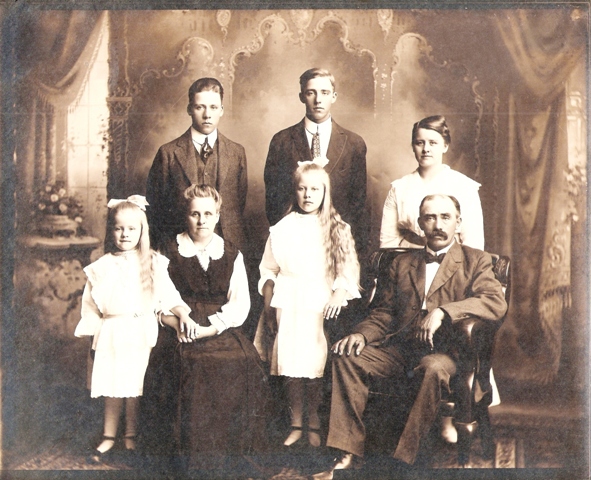
Back row: Menne, Wilbur, Anna. Front row: Alma, Christina, Lydia, John.

In a close-up of the folks shown above, you will see the officers of the church as well as ministers and their wives.
My Grandfather, John, is seated fourth from the left. 
The church was an extremely important part of the Plucker life. My Great Grandfather, Menne Albert, gave the land on which the Germantown Church is located. In addition, he gave the land for the Germantown Cemetery which is right across the road from the church.

As time went on, my Grandparents Plucker moved the family from the farm into the town of Lennox, South Dakota, a distance of about eight miles. Their house was always referred to as "the big house" because of its height and many rooms. That house is over 100 years old and is still on the same site. However, the town the Lennox has built up around it on all sides.

I will leave you for this posting with one of my favorite pictures: The baby in this photo is my father, Menne Elvin Plucker (born in 1900). Behind him is his brother, Wilbur and his sister, Anna.
I have this in a large (18 x 22) beautifully framed picture that my Aunt Alma very graciously gave me many years ago.