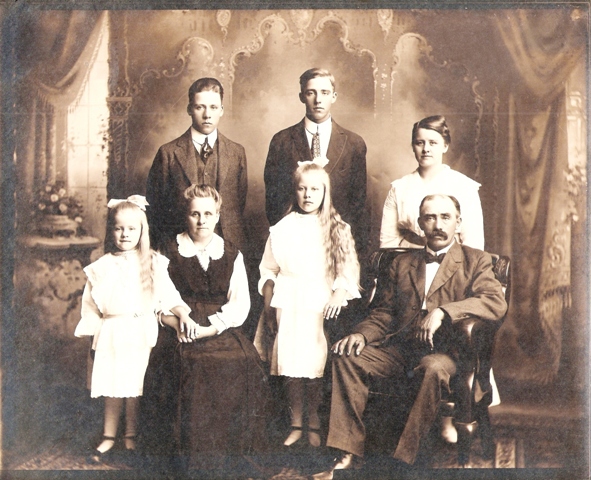
Saturday, April 7, 2012

TIME OFF

I'm taking some time to look for and edit more family stories from a different family link.
In the meantime, pick a story from my contents list below.
Just go to the blog archive on the right,
pick a month and then a story.


3/3/11                   Grandpa Thaden’s Story

3/9/11                   One Very Old Letter

3/9/11                   A Very Old Church Newsletter

3/10/11                Another Mystery (Two letters by Great Grandma Thaden)

3/11/11                I wonder - - - what my Great Grandmother went through

3/14/11                Would you like to Build a Sod House?

3/17/11                A Sod Church – The Thadens first Church in Minnesota

3/26/11                Dena Thaden Plucker’s Story – Part I

3/28/11                Dena Thaden Plucker’s Story – Part II

3/30/11                Dena Thaden’s Nursing Memoire

4/1/11                   Dena Thaden Marries Menne Plucker

4/27/11                Four Generations of John Poppe Plucker

8/7/11                   Bremerhaven – The German Emigrant Center

9/1/11                   The Poppen Connection

9/1/11                   Menne A. and Engel Plucker

12/1/11                The Pleasant View Cemetery

12/5/11                A Christmas Story (Cindee’s doll – the car in the snowy ditch)

1/12/12                Plucker Family Photos

1/23/12                Autobiography of MEJ Plucker - Introduction

1/26/12                MEJ’s BIO – The Early Years

2/2/12                   MEJ’s BIO – Transportation

2/8/12                   MEJ’sBIO – Threshing Time

2/15/12                MEJ’sBIO – The 1920’s

2/29/12                MEJ’s BIO – The Dirty Thirties

3/7/12                   MEJ’s BIO – The Family

3/14/12                MEJ’s BIO – Germantown Church

3/18/12                MEJ’s BIO - Conclusion

Sunday, March 18, 2012

INSTALLMENT NINE - MEJ's Bio (Conclusion)

Conclusion

                You remember I said that my parents decided I was to be a preacher. I am convinced now, after all that has happened that the Lord had a very pronounced hand in the things that came about. During those three years that I spent in school in Dubuque, I spent much time singing with different organizations. Even though I was enrolled in the Academy or High School part of the school, I was a member of the college Glee Club.

               Also the head of the vocal music department organized a mixed double quartet to sing every Sunday morning in the downtown church. It was my good fortune to be a part of that. Also, I was given many pointers in the art of directing a choir by this same lady. So now I am firmly convinced that all this was in preparation for the time when we were to move back to South Dakota just one fourth mile east of the Germantown Church.

                This happened in 1934. In 1936 a Men’s Octet was organized and I was chosen as its leader. From 1936 until 1954 I was always connected with the music program of our church. Several times during those years we presented Easter and Christmas Cantatas with as many as 50 voices.
1946 Men's Chorus.
Dorothy DeVries, pianist; Wiert Eekhoff, Pastor

1955 Contata Choir
MEJ Plucker, Director

               The Octet that was organized in 1936 is still in existence in 1966, but is now known as the “Men’s Chorus” with a membership of about 15 or 16, instead of the original eight men.
        
               This seems to be the end of my ramblings about things that happened to me. Of course, there are many more events that I could have mentioned but they are of small importance to anyone but me.

                I hope that the effort I have put forth


is of enough interest so the person reading it


can stand reading all of it.


If not, so what?


Paper is cheap and so is my time.

Note: I wonder what MEJ would say if he could know that his writings would be posted on a page of the Internet. He would have been an avid user of the new technology, I know, although he might not have been so bold as to put his own story out there. But I am proud to be able to share his story and hope that it tells just a small bit of what his life was like from 1900 to 1968 when he died.


Wednesday, March 14, 2012

INSTALLMENT EIGHT - MEJ's Bio (Germantown Church)


Germantown Church
                Perhaps an account of the history of the Germantown church building would be if interest. As stated before, it was organized in 1886 and was built on land donated by my paternal grandfather. The first building was a wooden frame building, built mostly by the charter members of the church. It would seat about 100 people. The first heating system was a large coal and wood stove, standing in the very center of the auditorium, and the stove pipe hung from the ceiling all the way to the end of the church, directly over the pulpit.
               Some time after this a sort of basement was dug under the church and a coal furnace installed. This was a great improvement since the stove was taken out and pews put in its place. The lighting system, of course, was kerosene lamps until a very complicated system of gas was added. The gas was manufactured by adding water to carbide in a large pressure tank outside the church. This system was replaced by electricity. More room was needed in the so-called basement to accommodate the gasoline powered generator and twelve large glass storage batteries. This system of lighting served the church until 1948 when the power line finally came out this far.
                When the congregation was organized in 1886, the first building to be erected was the church. The foundation was rock laid on the ground, no concrete. The lumber had to be brought from Parker, ten miles away. When you consider that all this was accomplished with horse power, it looks like a big undertaking.
                After the church and the manse were built, some of the people thought that it was necessary for the horses that were used to come to church, to have shelter during the time services were being held. So another project was started. A barn that had room for fourteen teams of horses was built. Each stall was built for two horses and the name of the man whose horses were to be in that stall was nailed above that stall.
               This barn, although it was no longer used for horses, was still in existence until the late 1920’s or early 1930’s. During the time that it was in use by the people, it happened quite often that while the services were going on in church, one could hear horses squealing and the sound of kicking against the partitions. Then one of the men of the congregation would quietly get up and go straighten out the quarrel.
Germantown Church with the Sessionj
Early 1900's

Wednesday, March 7, 2012

INSTALLMENT SEVEN - MEJ's Bio (The Family)


Bobby and Dotty

The Family

Because we moved around a lot during our early married life, our three children were born in three different states. Dorothy June was born soon after we moved to Princeton, Illinois. She grew up to be a cute curly-headed little girl, the kind that made people turn around for a second look when she was old enough to go shopping with her mother. When she was still just a little girl, she showed signs of becoming a good house keeper because she helped her mother with the dusting and sweeping and other household chores. After going through grade school, high school and a short normal course, she taught a country school for two years. Then she decided to become a farmer’s wife, which is a fairly permanent job any way you look at it. (Pictured on the right is Menne (MEJ), Dorothy June and Grandpa John P. Plucker)

Bobby & Dotty at 9 & 11


Robert Elvin was born while we lived in Dubuque, Iowa. When he was small he would spend hours watching the wheels go around on his toy train and his many toy trucks, so we expected he would be a mechanic when he grew up. That changed soon after he got into high school and found out about music, especially the vocal kind. As soon as he graduated from high school he enlisted in the army – to keep from getting drafted. He was sent to State College at Brookings, South Dakota for a short while, then inducted into the paratroops. He had a teaching position at Faulkton, South Dakota, but since he was still in the reserves, he was called back into service and sent to Korea for a year. Since that time he has been music instructor in Winona, Minnesota and Green Bay, Wisconsin. He married a college schoolmate who is also a teacher. 
Bobby, Jeanie, Dotty - 1939


Dots, MEJ, Dena, Jean, Bob - 1945


Jean Ellen, our youngest, was born here in South Dakota where we now live. One reason she was named Jean was because for a year or so before she was born, there was a complicated musician’s strike going on that made it impossible for radio stations to play any kind of music except these numbers on which the copyright had run out. All of Stephen Foster’s songs were in this classification, so the song “I Dream of Jeanie With the Light Brown Hair” was usually heard several times a day. Also, the name, Jean, is the feminine counterpart of the name, John, which was her grandfather’s name. Besides all of that, we like the name. We had no idea that she would some day marry a man named Gene. It seems to me that even when she was real small she had an idea she wanted to marry a minister. If that was true, she succeeded famously.
Jean Ellen, Robert Elvin, Dorothy June - 2011


Wednesday, February 29, 2012

INSTALLMENT SIX - MEJ's Bio (The Dirty Thirties)

Menne and Dena on the left - with friends.
Around 1924
This is the actual elevator that MEJ
managed in Lennox.


The “Dirty” Thirties


In 1930 we moved to the farm that my father owned, consisting of 160 acres. That was the first year of drought and depression that lasted for about six years. Normal rainfall for this part of the country is in the neighborhood of 25 or 26 inches, but during those dry times we were lucky to get 15 or 16 inches per year. Crops were almost non-existent in those years. I remember walking over (picking) a 100 acre field of corn and when it was all done the corn I had found was contained in one wagon. It was not the drought alone that bothered the people of that time, but also a depression all over the country.
<><><><><><><><><><> <><><><><><><><><><> <><><><><><><><><><>
Dust storm approaching Stratford, Texas Dust bowl surveying in Texas
Image ID: theb1365, Historic C&GS Collection
Location: Stratford, Texas
Photo Date: April 18, 1935
Credit: NOAA George E. Marsh Album
Here in South Dakota, our greatest drawback was the constant threat of dust storms. Since the soil was so dry, it needed just a small breeze to start the dust to roll along. In some places the dust banked up like snow, sometimes covering fences four feet high. It also sifted into houses, covering window sills and floors with a fine layer of dust. I heard one lady say that she was going to dust up the house; the dust on her floors and window sills was getting stale. She wanted some fresh dust.
<><><><><><><><><><> <><><><><><><><><><> <><><><><><><><><><>
http://blacklegacres.tripod.com/horse_farming.htm


It might be of interest to recount a few of the things that happened to us after we started farming. We had no money to buy the needed equipment, so with financial help from my father, the grocery store owner, and the implement dealer we managed to plant and then harvest the first crop. This was the year 1929, and it was 10 years later before this debt was finally paid. Even so, I bought no new machinery, just used equipment that I was able to pick up at farm sales. In 1929 tractors were not very popular as yet, so horses were still very much in use. The first ones I bought were black mares called Polly and Flossy. My father still owned two horses that I was able to borrow for the first season. I got along with just the four horses for the first season.

In the fall of 1929 I bought two horses from a neighbor. Those two were named Shorty and Luey, but they were well along in years so they didn’t last very long. To replace them I bought Nellie from an uncle, and a little later a more or less wild bronco from a horse peddler. Her name was Lady, but she was no lady. 
<><><><><><><><><><> <><><><><><><><><><> <><><><><><><><><><>
German horses - from Ostfriesland, 2011
Still later I acquired Bell and Queen. By this time tractors were becoming more popular and also a little more useful. The first tractor I bought was a used Huber and it was a flop. It weighed several tons, and had enough power to pull your hat off if it was helped a little... I couldn’t even trade it in on another tractor so I sold it for junk. Next I bought another used machine, this time a Rock Island. It, too, was a very heavy, steel-wheeled machine, but at least it did the work it was supposed to do, and it eliminated the need for so many horses. In 1941 I bought a modern row-crop type Minneapolis Moline tractor which I used until I quit farming.
<><><><><><><><><><> <><><><><><><><><><> <><><><><><><><><><>
http://tranctorsused.com/?page_id=22
This may not be exactly like the Minneapolis Moline my Dad bought, but it is close.
This one was announced in July of 1937 as their Universal Z model.


Wednesday, February 15, 2012

INSTALLMENT FIVE - MEJ's BIO (The 1920's)

The 1920’s
Alma, Menne, Christina, Wilbur, Lydia, Anna, & John Plucker in 1916.

MEJ in his football uniform at Dubuque.

In 1916 my brother decided to enter the ministry, and went to start his education at what was then known as “The “Dubuque German College and Seminary.” It also had a department known as the Academy, which was only for those who had not gone to high school. After he had been there for a year or so, he was drafted into the army. World War I had been going on since 1914, and the United States had also become involved. He had to be inducted in his home state, so he came home a few days before he was to leave. It was during those few days that he was accidently killed by a fall from a horse. 
(We will never know what part Wilbur's death played in my father's life from then on, but suffice it to say: it was significant since he gave it such importance in his story.)

 
MEJ's big baritone saxophone.
                 In 1917, my parents (mostly my mother) decided that I should go into the ministry, so I went to Dubuque. Then I too, was drafted to go into the army and was to leave on November 15, 1918. But since the war stopped on November 11, 1918, I received a telegram not to appear for induction. I kept on going to school in Dubuque until 1920, when I became (what is now known as) a dropout. I came back to South Dakota and went to work for one of the neighbors, since my parents had moved to town and therefore had no work for me.

John & Christina Plucker, Menne & Dena, Minnie & Eilert Thaden.
The girl I married, I met in Dubuque in 1920. The very first time I ever saw her I was in a friend’s room on the third floor and she on the street below, walking from her room to the school dining room. This friend, in whose room I was, knew her since they were both from the same community. He did not believe me when I told him, “There goes the girl I’m going to marry some day.” I never had any doubt about her being the right one for me, and I’m glad I was able to remove any doubts she may have had, because four years later we were married.***

                In the fall of 1921 my father bought a grain elevator in Lennox, and I was to be the operator of this grain-buying station. We kept this business venture going until some time early in 1926 when he sold out. This adventure into the business world should not be classed as a huge success.

                After the grain elevator was sold, we decided to move to Princeton, Illinois where I was to work for my sister’s husband who was a medical doctor, but owned considerable farm land, too. This job did not last very long because the rest of the help resented me. It would probably have been better if I had not been the brother-in-law of the boss. Then I sold life insurance for a while in and around Princeton, but with my low-pressure salesmanship to hold me back, it didn’t pay off very well. So one day I went back to Dubuque to look for a different job. Since this was just before Christmas, I got temporary work in the Kresge 5 and 10 cent store, at least until after the holidays. But it ended up with my staying at the same job for a little over a year. However, I was just not enough of a “city feller” to stay there any longer, so we went back to South Dakota where we rented a farm northeast of Lennox. We would no doubt have moved on one of my father’s two farms then, but they were both rented for another year.

Note: I could make many comments about this section of his autobiography, but I prefer to let it stand on its own.
*** Go to previous postings dated 3/26/11, 3/28/11, 3/30/11 and 4/1/11 for Dena's story and the clipping of their marriage.

Wednesday, February 8, 2012

INSTALLMENT FOUR - MEJ's BIO (Threshing Time)

Threshing time
 
The thresher was powered with steam using the belt system.
During the teens and the twenties, the work of harvesting and threshing grain was somewhat different than it is in the sixties. Horses were of course used to pull the grain binder, and as soon as it was cut down it had to be shocked up again. This job almost always came during the hottest part of the summer with the thermometer somewhere between 90 and 105 degrees. After the grain had stood in shocks for a week or so, anywhere from eight to twelve neighbors would band together to form a threshing ring. Then a steam threshing rig would be hired to do the threshing job. It was always a highlight in a small boy’s life to see the enormous steam engine pulling the threshing machine into the farmyard. It was big and black, it belched a lot of black smoke, and it had many mysterious little gadgets on it, such as a system of water pipes to inject water into the boiler, the governor, the big belt wheel and all the other little wheels, to say nothing of the most interesting part of all – the WHISTLE.

Pitching bundles into the steam thresher.
                  For a steam rig like the ones that used to come to our place, the crew consisted of an engineer, separator man, and water boy. The engineer was kept busy seeing to it that the steam pressure in the boiler was kept at the proper level, somewhere around one hundred and twenty pounds, if my memory is reliable. The separator man’s job was to keep all the bearings and axles on the threshing machine oiled, adjusting the straw blower from time to time to build a nicely shaped straw pile, and seeing to it that the grain wagons did not run over. The water boy was responsible for getting the water needed for the steam engine. His equipment consisted of a team of very tame horses. They were hitched to a wagon on which was mounted a three or four-hundred gallon tank. The engine usually required two tanks of water every day. That meant the water boy had to scout around and locate either a pond full of water or perhaps a creek where he could fill his tank by the use of a hand-operated force pump. If he was slow in getting back with his load, the engineer would summon him with three long blasts on the whistle.
This machine is more indicative of the machines running in the 40's and 50's.
                The whistle on the engine was also used for other signals. For instance, two long blasts meant that the men unloading grain at the bin were taking too much time; the wagon at the threshing machine was in danger of running over. A series of short toots was to tell whoever was next in line to unload bundles into the machine that he had better get on his load, even if he wasn’t quite satisfied with its size, and tear for the rig or take a lot of ribbing from the rest of the crew later on.

                After the day was over, the fire would be allowed to go out in the fire box of the engine. That allowed the steam pressure to drop to zero. In the morning the engineer was on the job long before daylight, to start the fire in the engine. Just as soon as he had enough pressure to make any kind of noise with the whistle, he pulled the string. This was to notify any other engineer of any other rig within hearing distance, “I’m here and I’ve got steam pressure up, how about you?”

                Another noticeable thing was the rivalry between the ladies who did the cooking for the crews. The meals that were placed on the tables were cooked with one idea in mind: “this dinner has to be better than the men got at so-and-so’s place yesterday.” Since the entire crew consisted of either eight or ten bundle-pitchers, two grain scoopers, the engineer, the separator man and the water boy, it had to be a fairly large dining room to accommodate everyone.

*** Stay tuned for Installment #5.